
If you're reading this article, you probably already know what a customer scorecard is. But just as a refresher, a customer scorecard is a structured performance rating that an OEM or prime contractor issues to its suppliers on a regular basis.
These scores are often calculated after considering several factors such as:
- Delivery
- Quality
- General Performance
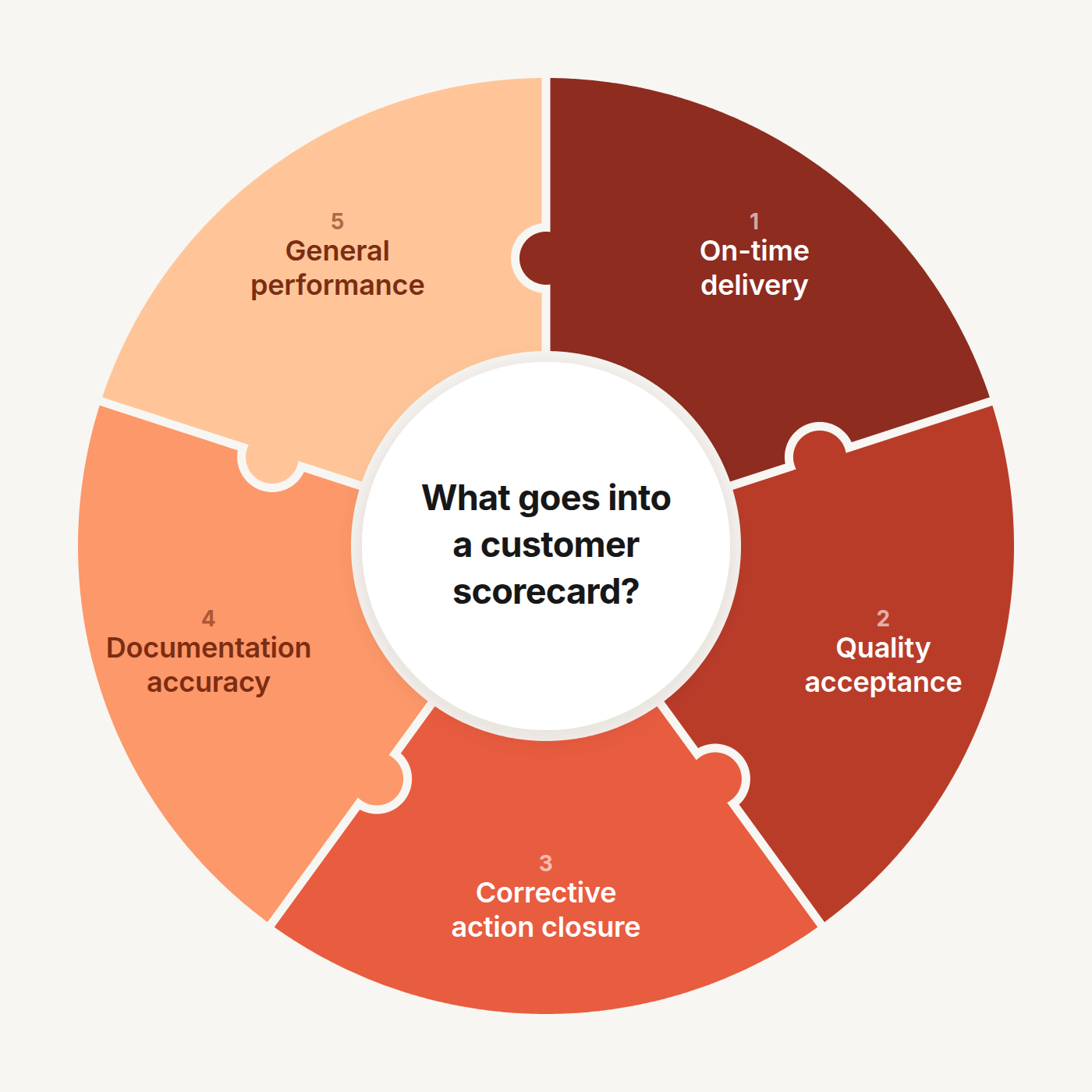
These scores can be delivered numerically, as a percentage out of 100, tiers (such as red, yellow, green, bronze, silver, or gold), or whatever form your customer chooses.
For most quality teams, this scorecard has a significant influence over customer satisfaction, revenue, customer retention, and more. While this may seem daunting to some, it's actually more of a relief. The thing about the scorecards is that they are quite mechanical, built from measurable inputs on a rubric your customer is leveraging. Once you understand the scorecard, you can manage it, rather than having your fate in someone else's hands.
1. Get the rubric in writing, including the weightings
Most quality managers can tell you their current score. But what's even more important is understanding the formula that produced the score.
Ask your supplier quality engineer or buyer for the scoring guide, and be specific about what you need:
- The weighting of each category. Delivery and quality are rarely equal, and many programs carry a third subjective category covering responsiveness, program support, or business management.
- The averaging window. A rolling twelve month average is common, and it means one bad month follows you for a full year. A three month window means you can recover quickly, but slip just as fast.
- The color thresholds. The bands between tiers are often narrower than a percentage point on quality, so knowing exactly where you sit against the next threshold changes how you triage a marginal lot.
- What counts as a hit. This is the part suppliers may overlook, and it is covered in the next two sections.
2. Find out which clock you are being measured against
Delivery looks like a simple metric but it is usually the one suppliers dispute the most, because ship date and score date are frequently not the same date.
Work through the following questions with your customer:

- Is the metric based on when the parts leave your dock or when they arrive at theirs? If it is receipt based, transit time is something to consider.
- What is the acceptance window? Many primes score early deliveries as misses outside a defined number of days, because early parts consume their inventory carrying cost and floor space.
- Does the clock run against the original purchase order date or the current revised date? If your customer pulls a date in, some systems keep scoring you against the original and some do not.
- How are customer caused delays handled? Some examples may include late government furnished material, a drawing revision that lands mid build, a hold placed by the buyer, or a delayed source inspection visit all push your delivery and there should be processes in place to handle these.
3. Treat paperwork rejections as quality rejections, because that is what they are
Sometimes you may have a part that is produced dimensionally perfect, but the FAI package may still have inconsistencies. Perhaps a characteristic on the balloon drawing does not match the Form 3 line, the material certification might reference a superseded specification, the Form 1 does not list the correct sub tier suppliers, or the report was submitted against Rev B when the purchase order calls out Rev C.
The receiving organization then writes a nonconformance, which then flows into the same quality metric as a cracked casting.
In order to avoid documentation discrepancies, you can follow these two steps:
- Make sure you know when a FAI is required. A full or partial First Article Inspection is required not only at initial production, but after a design change affecting fit, form, or function, a change in manufacturing source, process, inspection method, location, or tooling, a change to the numerical control program, an event that could adversely affect the process, and a lapse in production of two years or whatever period your customer specifies. Suppliers get scored for missing FAIs far more often than for failing them.
- Ensure you're validating customer specific flowdowns before the package ships rather than after it is rejected. Every prime layers its own requirements on top of the standard: a particular certification format, an approved process source list, a required serialization scheme, a specific way of reporting non conforming characteristics. Those requirements live in purchase order clauses and quality manuals, and they change without a lot of fanfare.
This is the workflow GroundControl was built around. Ballooning and characteristic extraction come off the drawing automatically, the AS9102C forms are generated from that same characteristic data rather than retyped into a spreadsheet, and customer flowdown rules are checked against the package before submission.
4. Answer corrective actions like the scorecard is watching
Most customer scorecards also score your corrective action process, but separately, and the timing expectations are fairly rigid. Typically, acknowledgement and containment is expected within 24 hours, an interim report with initial root cause direction inside three to five days, and verified closure somewhere between ten and thirty days.
In order to have your corrective action process scored positively:

- Acknowledge immediately – containment starts when the SCAR is issued, not when your team gets to it.
- Go deeper than "operator error" as a reasoning. Often times, reviewers reject it, the response comes back, and you're back at ground zero. It's important to clearly identify what the operator error was.
- Track recurrence. Many customers measure the percentage of corrective actions with no repeat inside a monitoring window, so a fast close that does not hold is worse than a slower close that does.
Read our case study to see how one of our customers switched over to GroundControl, after their formal corrective action. By using GroundControl, they were able to improve the accuracy of their FAIs and improve customer satisfaction. Read the full story here.
5. Score yourself before your customer does
In order to anticipate how your customers might score you, you could build an internal version using the same definitions your customer uses, including their delivery clock and rejection reasons.
By scoring yourself against the customer scorecard, you can stay on top of your customer satisfaction and retention, and have ample time to solve for any corrective action that may be required.
Watch trends rather than pass or fail results. A characteristic drifting toward a tolerance limit across three lots is a scorecard event you still have time to prevent.
6. Show your work
Overcommunication is key to ensuring you are a trusted supplier. Some ways you could do this include sending a short monthly note to your supplier quality engineer covering what shipped, what was rejected and why, what corrective actions are open and where they stand, and what you changed.
If your buyer needs to defend you as a supplier internally, it will help them to have all of the evidence ready at any such meetings.
A scorecard is a summary of things that already happened. The work is upstream: knowing the rubric, protecting the delivery clock, shipping documentation that survives review, and closing corrective actions properly the first time. Do those four things consistently and the color takes care of itself.
GroundControl helps aerospace and advanced manufacturing teams generate AS9102 First Article Inspection reports, validate customer flowdown requirements before submission, and manage supplier corrective actions in one place.