← Back to Insights
[ FAI ]

How to Actually Fill Out an AS9102: Forms 1, 2, and 3

How to complete AS9102 Forms 1, 2, and 3 for Rev C FAIRs

July 31, 2026 • 5 min read • GroundControl Editorial Team
AS9102 FAIR FAI Form 1 Form 2 Form 3 First Article Inspection aerospace quality
How to Actually Fill Out an AS9102: Forms 1, 2, and 3

An AS9102 First Article Inspection Report is three linked forms: Form 1 accounts for the part, Form 2 accounts for its materials and processes, and Form 3 accounts for every drawing characteristic. Most rejections happen because the three forms disagree with each other, not because any single field was wrong. See Top Five Reasons for an FAI Rejection for the patterns reviewers catch most often.

What are AS9102 Forms 1, 2, and 3?

Form Official name What it proves
Form 1 Part Number Accountability Which part, which revision, why an FAI was triggered, and who signed off
Form 2 Product Accountability – Materials, Special Processes, and Functional Testing That every material, special process, and functional test meets spec, with certs to back it
Form 3 Characteristic Accountability, Verification and Compatibility Evaluation That every ballooned drawing characteristic was measured and passed

How do you fill out Form 1?

This form is used to identify the product that is having the First Article Inspection (FAI) conducted on (for example, a detail part, sub-assembly, or assembly), referred to as the FAI part.
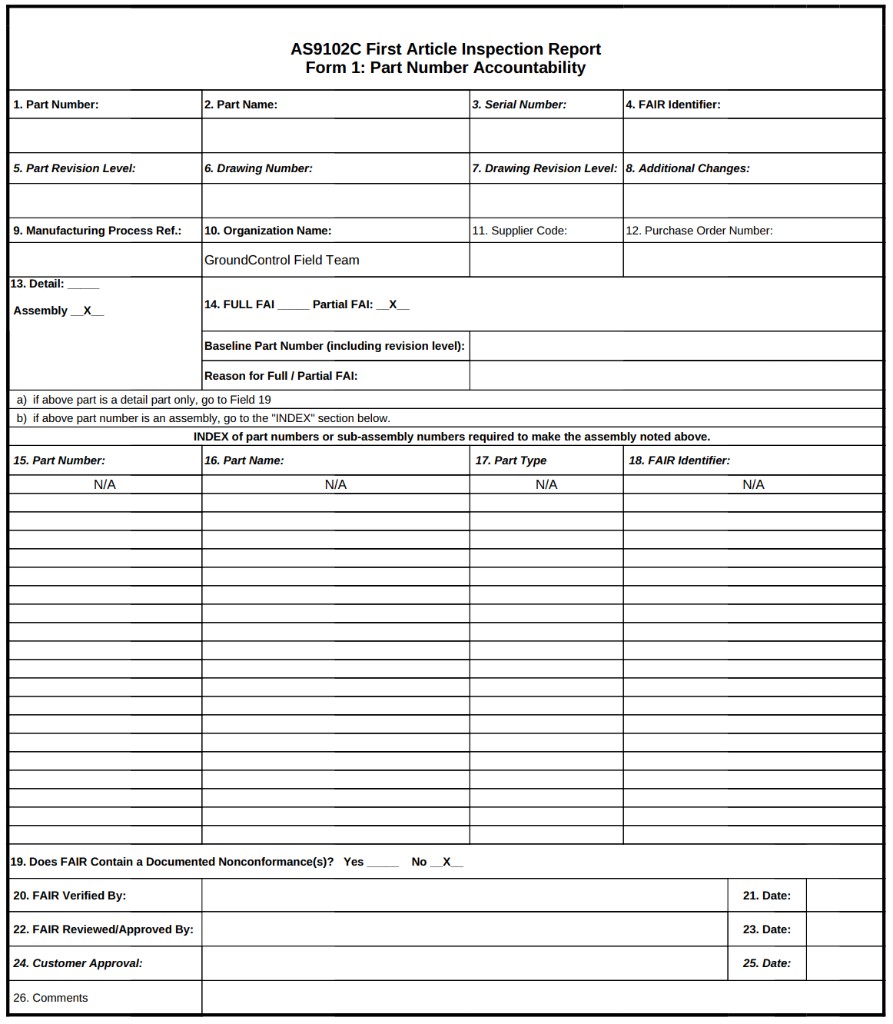
AS9102C Form 1 Part Number Accountability template with numbered fields
AS9102C Form 1: Part Number Accountability Click to enlarge
  • Part number, part name, and drawing revision: copy these exactly from the title block, including the revision letter.
  • FAIR Identifier: your unique ID for this report. Use the same string on all three forms and on every piece of objective evidence.
  • Reason for Full / Partial FAI: under Rev C this is required on every FAIR, not just partials. Be specific: "first production run," "design change to Rev D," "two-year lapse in production," "change of manufacturing location."
  • Part Type and BOM detail: for an assembly FAIR, list all BOM parts and reference each sub-component's own FAIR.
  • Nonconformance declaration: state plainly whether the FAIR contains a documented nonconformance.
  • Reviewed by / Approved by: Rev C expects these to be two different people. Ensure your workflow actually enforces it.

How do you fill out Form 2?

This form is used if any materials, special processes, or functional testing are defined as a design characteristic.

For every material, special process, and functional test called out on the drawing or in the spec tree, record one row: the material or process name, the specification number and revision, the supplier and their approval code, and the certificate number that backs it.

Three things reviewers check first:

  • Spec revisions match the drawing. A cert to AMS 2700 Rev E against a drawing calling Rev F is a finding.
  • Special process suppliers are customer-approved. Nadcap accreditation alone is not the same as your customer's approved-source list.
  • Every row has a traceable cert number. "On file" is not a cert number.
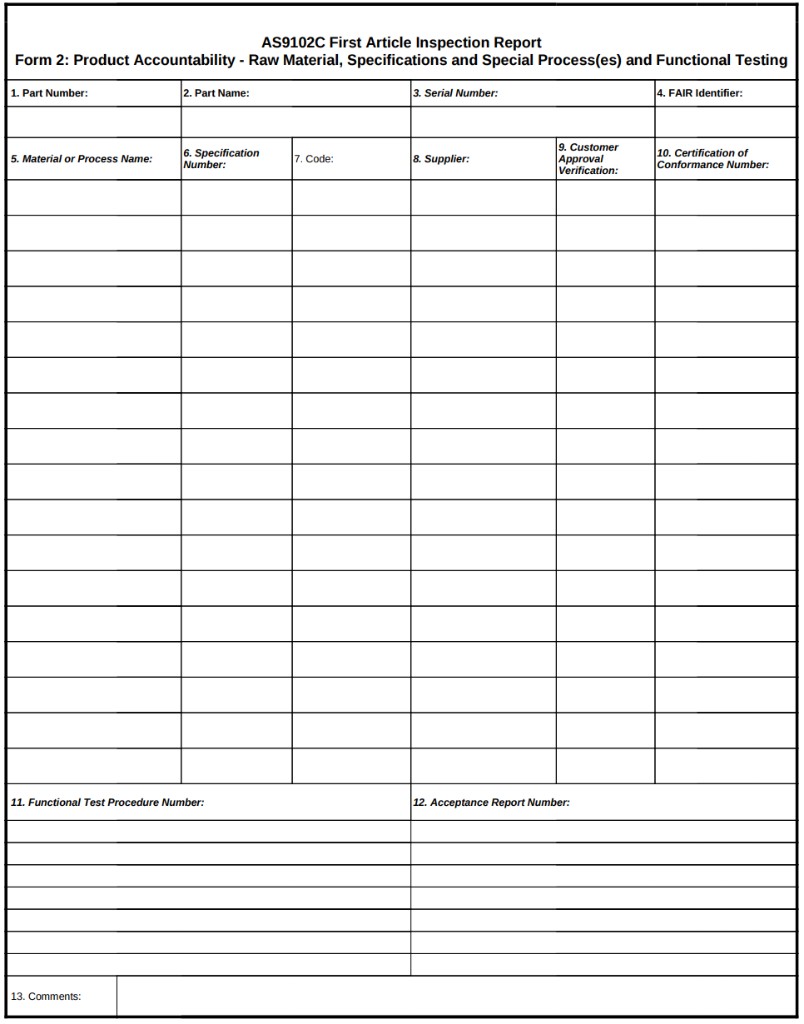
AS9102C Form 2 Product Accountability template for materials, special processes, and functional testing
AS9102C Form 2: Product Accountability Click to enlarge

How do you fill out Form 3?

This form is used to record inspection results for the design characteristics and to document any applicable nonconformances (reference section 4.5).

  • Balloon the drawing first. Every dimension, tolerance, note, GD&T feature control frame, and flag note gets a unique balloon.
  • One balloon = one characteristic number = one row.
  • Reference Location: record the drawing zone or sheet so a reviewer can find the requirement in seconds.
  • Characteristic Designator: flag key and critical characteristics here. Missing a flagged characteristic is a hard rejection.
  • Requirement: transcribe the nominal and tolerance exactly as drawn, including basic dimensions and units.
  • Results: record actual measured values, not "OK" or "pass." Variable data where variable data exists.
  • Designed Tooling and Nonconformance Number: populate where applicable rather than leaving them blank without reason.

Then reconcile: your highest characteristic number should equal your balloon count. If they differ, something was missed.
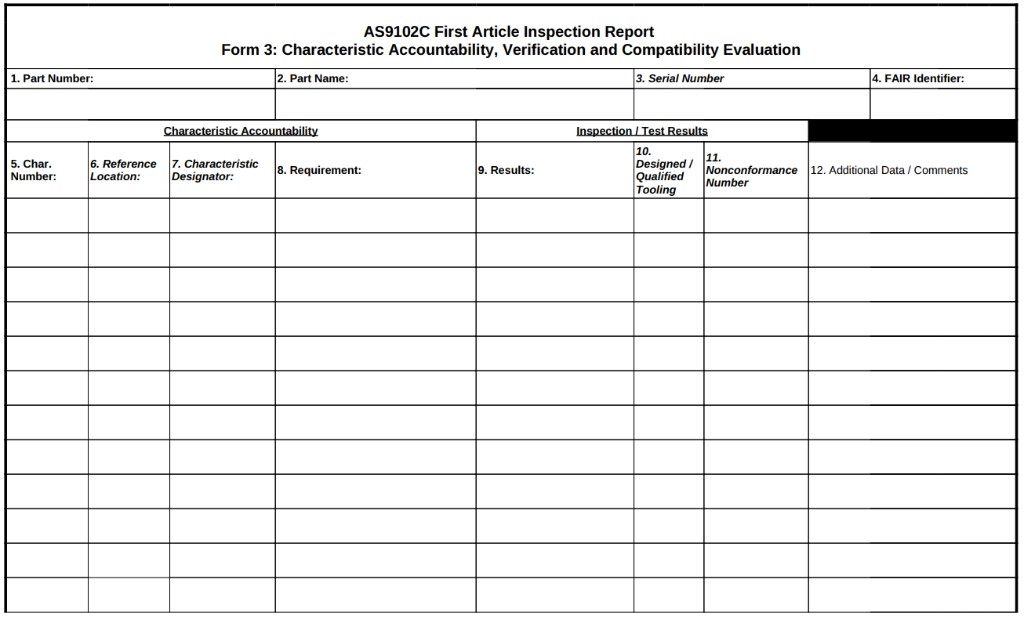
AS9102C Form 3 Characteristic Accountability template with characteristic and results columns
AS9102C Form 3: Characteristic Accountability Click to enlarge

Ready to simplify your AS9102 workflow?

GroundControl automates ballooning, Form 1–3 assembly, and tolerance validation so your team produces audit-ready FAIRs faster, with fewer rejections. Explore First Article Inspection software or book a demo to see how it fits your workflow.


Key takeaways
  • Form 1 identifies the part and the FAIR. Form 2 proves materials and special processes. Form 3 proves every characteristic.
  • Balloon the drawing before you touch Form 3. Balloon numbers become characteristic numbers: one balloon, one row.
  • Rev C (published July 2023) renamed several Form 1 fields, removed the Form 2 signature, and added a Requirement field to capture embedded software.
  • Rev C also requires that the person reviewing the FAIR is not the same person approving it.
  • The most common failure is inconsistency across the three forms: mismatched part numbers, revisions, or FAIR identifiers.
FAQ
Do I need a separate FAIR for each serial number?
No. An FAI covers a representative part from the first production run. You need a new or delta FAIR when a design, process, tooling, or location change affects fit, form, or function, or after a lapse in production if your customer specifies one.
What's the difference between a full, partial, and delta FAI?
A full FAI verifies every characteristic. A partial FAI verifies only the characteristics affected by a specific change. A delta FAI is the common industry term for a partial that references the original FAIR. Under Rev C you must state your reason either way.
Can I write "pass" in the Form 3 Results column?
Not for anything measurable. Attribute results are acceptable for pass/fail requirements, but variable characteristics need actual values. "Pass" against a ±0.005 tolerance is one of the most common rejection causes.

[ RELATED ARTICLES ]

[ TESTIMONIALS ]

Trusted by quality teams

J

Jim Pacheco

Director, Quality Assurance

I recently started using Ground Control, and I have been thoroughly impressed with its functionality. This software stands out with its easy-to-use ballooning tools and highly accurate note recognition, which collectively enhance my productivity. Ground Control is an excellent investment for anyone seeking a powerful and user-friendly solution that simplifies complex processes. Thank you Ground Control Team!!!
Karla Perez
Karla Perez

QC Inspector @ Summit Interconnect

Using the Ground Control software was a game changer for our organization! The use of the software has allowed us to process jobs through production and final inspection more efficiently with fewer mistakes and delays than ever before. I would not hesitate to recommend this product to a friend or other small, medium or large business that wants to see immediate return on their investment.
Steve Baker
Steve Baker

Quality Manager @ FFMP

GroundControl is a game-changer. It's cut our FAI times by 50-70%.
P

Peter

CEO @ Lake County Tool Works North

GroundControl completely streamlined our first article process! The software is user friendly, intuitive and eliminates the manual errors we used to encounter when preparing AS9102 forms. I highly recommend this software for any company looking to enhance proficiency.
J

Jasmin Chihocky

Quality Supervisor @ US Circuits

GroundControl's AS9102 software has transformed our FAI process at Phenx Products, enhancing compliance and data accuracy significantly. Its intuitive interface and dependable functionality have boosted our efficiency in quality management and getting parts out the door.
Marcus James
Marcus James

COO @ Phenx Products

Just want to thank you for your dedicated service to always answering questions and making the software as user friendly as it can get. We are definitely seeing time savings in regards to creating FAIR's and the accuracy of number and letter recognition is great.
Omar Delgado

Omar Delgado

Quality Manager @ Cupps Industrial Supply

I can tell you that Ground Control has been a game changer. As we have more customers in demand with AS9102 requirements, having Ground Control has become a necessity for me, not just a luxury.
L

Laura Macias

Quality Inspector @ Emerald Technologies

Stay in touch

Stay in the loop with GroundControl

We'll only share the most useful updates for modern quality teams.