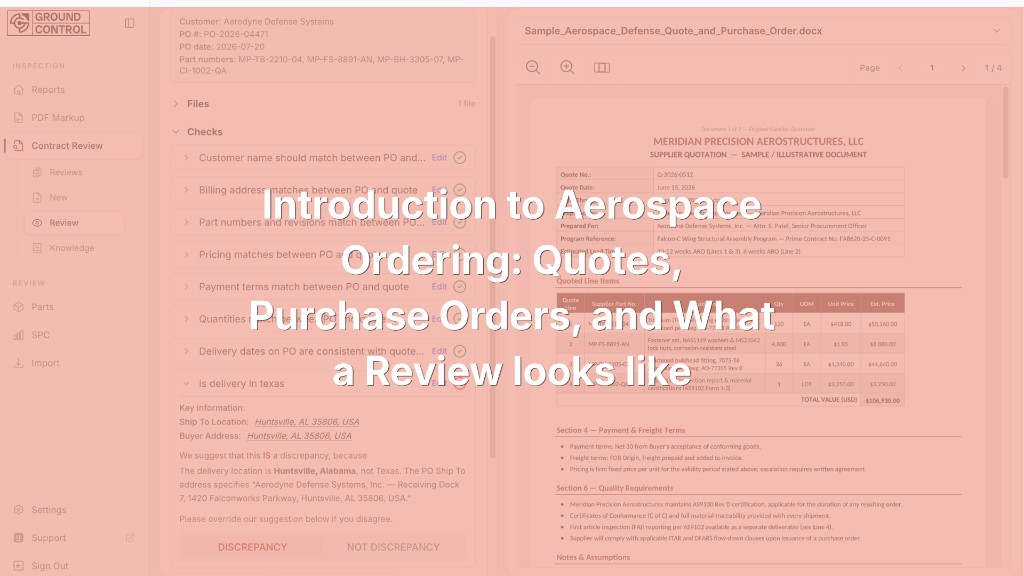
Before starting production on a purchase order (PO), it needs to be compared to the accepted quote for things like price, part number, dash number, drawing revision, quantity, quality flow-downs, FAIR and cert deliverables, delivery dates, DPAS rating, contract terms, and more. Matching total price at the bottom of the PO and quote documents is not enough as there are many other components that could be mismatched.
A purchase order is created by the buyer, and a quote document is typically created by the seller. When a customer emails a PO, most shops save the PDF, enter the job, and then send over material. That treats the PO as a copy of the quote. However, they're not always exact copies of each other. A PO and quote can have different dates, a different dash number, extra quality clauses, or something else.
Why purchase order review is different in aerospace and defense
A promotional-goods distributor checking a PO is mostly protecting margin. An aerospace or defense supplier is also protecting configuration, airworthiness evidence, export-control posture, and on-time delivery scorecards.
AS9100 requires a coordinated review before you commit to supply, including customer requirements, statutory and regulatory requirements, and any difference between the order and what was previously quoted. If the PO cannot be met as written, you should negotiate a mutually acceptable requirement before accepting it, while maintaining all records of the review.
What is the difference between a quote and a purchase order?
The seller creates the quote document which describes what you are willing to supply, at what price, at which revision, and on which terms. The buyer creates the purchase order, which tells you what procurement has authorized for purchase.
Typically, the quote comes first and the PO follows internal approval. However, you should not treat the PO as a harmless copy of the quote. It may contain a different drawing revision, quantity, ship-to, quality manual, payment period, or set of standard terms.
| Quote | Purchase order | |
|---|---|---|
| Created by | Seller or contract manufacturer | Buyer, prime, or procurement team |
| Main purpose | Offer scope, configuration, price, and commercial terms | Authorize and record a purchase against a budget and contract |
| Typical timing | After RFQ, before the buyer decides | After internal approval, usually before production starts |
| Main reference | Quote number and revision | PO number, line items, and often a prime contract number |
| What it should match | The drawing, process, and lead time you can actually perform | The accepted quote, plus any flow-downs the buyer is required to pass through |
| Invoice role | Supports the agreed price and exclusions | Usually appears on the invoice for matching and payment |
Always ask the buyer to reference the quote number and revision on the PO so you can compare the two documents before you start work.
A typical aerospace quote-to-PO workflow

- The buyer sends an RFQ with a part number, drawing, and quality requirements.
- The seller sends a quote document with configuration, exclusions, price, lead time, and terms.
- The buyer completes internal approval, often through a procurement or MRP system.
- The buyer issues a purchase order, sometimes weeks later and sometimes from an older quote revision.
- You compare the PO with the accepted quote, the drawing, and your capability to deliver, including FAIR and certs.
- You send a written acknowledgment, with exceptions if the documents conflict.
- Production, special processes, and first article inspection begin only after the starting conditions are met.
- You invoice against the PO number and line items the buyer requires for payment.
Aerospace purchase order review checklist
| Check | What to compare | If it does not match |
|---|---|---|
| Buyer entity and quote reference | Legal name, bill-to, ship-to, CAGE, quote number and revision on the PO | Confirm you are contracting with the right entity and the quote they actually accepted. |
| Price | Unit price, NRE, tooling, FAI, certs, and total vs. the accepted quote | Do not start work. Ask the buyer to reissue or confirm the delta in writing. |
| Part identity and revision | Part number, dash number, nomenclature, drawing revision, model revision, PO revision | Stop. Wrong revision is a configuration error and a common FAIR rejection. |
| Quality flow-downs | Customer quality clauses, special processes, approved sources, packaging, FOD | Confirm you can perform or subcontract each requirement before you accept. |
| Deliverables | AS9102 FAIR, material certs, C of C, test reports, portal templates | Price and schedule the paperwork. An unpaid FAIR is still a delivery obligation. |
| Delivery and DPAS | Need date vs. quoted lead time; DX/DO rating and certification statement | Flag an unachievable date now. Rated orders have a written accept/reject deadline. |
| Terms and penalties | Payment terms, T&Cs, LDs, chargebacks, termination, warranty | Acknowledge subject to your quoted terms. Do not silently accept theirs. |
| PO revision delta | What changed since the last PO revision you accepted | Re-review only the changed lines, then update the job record before the floor uses the old PO. |
What quality clauses and flow-down requirements are on the PO?
Aerospace POs rarely stop at "make this part." They incorporate customer quality manuals, supplemental specs, approved-processor lists, counterfeit-parts clauses, packaging and FOD requirements, and statutory flow-downs such as ITAR / EAR restrictions when covered defense information is in play.
- Read the quality notes and every document the PO incorporates by reference.
- Confirm you have the correct revision of each referenced spec.
- Confirm special processes (heat treat, plating, NDT, welding) can be performed by a customer-approved source.
- Confirm you can legally receive and store any technical data the order includes.
A clause you did not price, cannot perform, or cannot flow to your sub-tiers is not a paperwork issue. It is an acceptance decision.
Is a purchase order acceptance of a quote?
It can be evidence of acceptance when it matches the quote but that is not a universal rule. A PO that introduces its own terms, a different revision, or extra deliverables may operate as the buyer's offer, or as a counter-offer, rather than as a clean acceptance of yours. Starting work or shipping hardware can have legal consequences even without a signature.
Use the same checks on every order:
- Make the quote number and revision visible on the quote you send.
- Ask the buyer to reference that version on the PO.
- Compare the documents before performance.
- Resolve conflicting terms in writing.
- Keep the final record together.
This article is practical commercial and quality guidance, not legal advice. Contract rules vary by jurisdiction and by whether the order is commercial, FAR-based, or a subcontract under a prime.
What is the difference between a purchase order and an invoice?
A PO is not an invoice. The buyer uses the PO to authorize and track the purchase. You issue the invoice to request payment.
Primes and government paying offices match the invoice to the PO or contract. If the invoice does not carry the correct PO number, line item, or configuration, accounts payable can return it even when the hardware was conforming. Under FAR 32.905, a proper invoice on a federal contract must include the contract number or other authorization, including order number and line item number. Many OEM supplier portals apply the same matching logic to subcontracts: no valid PO number, no pay.
Check whether the buyer requires one invoice per PO, separate invoices per line, a supplier-portal submission, or evidence of delivery such as a packing list or FAIR package. Do not invent a PO number, reuse another job's number, or assume a program manager's email overrides purchasing.
What a skipped PO review actually costs
A revision mismatch caught after production is rework, a rejected shipment, and a supplier-scorecard hit.
An undetected price gap is revenue that you cannot recover after delivery, a missed FAIR or cert requirement delays source inspection even when the part is good, and an unreviewed DPAS rating can put you in breach of a federal priorities rule.
The review takes minutes when it is a checklist. It takes weeks when it becomes a price discrepancy, a late shipment, and a commercial dispute. GroundControl's PO Review software runs that checklist against the actual documents, cites every finding back to the source clause, and drafts the discrepancy email so the buyer hears from you the same day.